Log Splitter Tonnage: Read the Number in Context
Log splitter tonnage explained: how the ton rating is calculated, what size you need for your wood, and why log length and cycle time matter as much.

For most firewood, 5 to 7 tons splits seasoned rounds up to about 10 inches across, 20 to 25 tons is the usual class for mixed hardwood and bigger rounds, and 30 tons or more is for big, knotty or green rounds. The ton rating is cylinder area times maximum pump pressure, a ceiling and not a promise. Match it to your largest rounds, then check log length and cycle time, which decide your day just as much.
Affiliate disclosureAs an Amazon Associate we earn from qualifying purchases.
Where the ton rating comes from
A hydraulic splitter's force is pressure times piston area. Champion's 32-ton manual gives the inputs: a 4.8-inch cylinder and 3,600 psi. The piston face is about 18.1 square inches, so 18.1 × 3,600 ≈ 65,100 lb, or 32.6 US tons. The label matches the math.
It does not always. Champion's 37-ton full-beam model has a 5-inch cylinder at the same 3,600 psi, which works out to about 70,700 lb, or 35.3 tons. Read the number on the box as the maker's figure, and compare cylinder bore and pressure when two machines look close.
| Machine | Rated force | Pressure | Cylinder or log capacity |
|---|---|---|---|
| Champion 201313 | 32 tons | 3,600 psi | 4.8 in bore |
| Champion 100330-1 | 37 tons | 3,600 psi | 5 in bore |
| WEN 56207 (electric) | 6.5 tons | 3,263 psi | logs to 10 in diameter, 20.5 in long |
What size log splitter do you need?
Start with the biggest rounds you plan to split, not the average ones, and with how stubborn your wood is:
| Your wood | Class to look at | Typical example |
|---|---|---|
| Seasoned, straight rounds up to about 10 in | 5–7 ton electric | WEN 56207: 10 in diameter, 20.5 in long |
| Mixed hardwood, bigger rounds, some green | 20–25 ton gas | 20–21 in logs on the 20 to 25-ton listings we track |
| Big, knotty or green oak, elm, rounds you cannot lift | 30–40 ton gas with vertical mode | Champion 32-ton: 24 in logs, 100 lb max in the beam |
Knots and twisted grain eat force: Penn State Extension sends knotty logs to wedges or a powered splitter rather than a maul. If your pile is mostly knotty, step up one class. If it is straight-grained and seasoned, you can step down. Our tonnage planner does this matching for your wood.
Log length and diameter: the other two numbers
Tonnage is useless if the round does not fit. Measure the length you cut for your stove and check it against the stated maximum: 20.5 inches on the WEN, 21 inches on the PowerSmart PS90, 24 inches on the Champion gas machines. Then check diameter. Small electric splitters state a maximum (10 inches for both the WEN and the PS90), and going beyond it is where they stall.
Weight matters as well. Champion caps the logs it wants on its beam at 100 lb, and heavier rounds are a job for vertical mode, where you roll them onto the foot plate instead of lifting. More in our horizontal vs vertical guide.
More tons, slower cycles
More force usually means a bigger cylinder to fill, and that costs time. Both Champion models above take 16 seconds per cycle, while the fastest 20 and 22-ton listings in our catalog claim 7 to 7.5 seconds. Our guide to the fastest log splitters shows how the claimed cycle times grow with tonnage.
So buying a 40-ton machine for 12-inch firewood gets you a heavier, slower and dearer splitter than you need. Buy for the toughest wood you really have, and let the planner check the rest.
Questions buyers ask
What size log splitter do I need?
Match it to your biggest, toughest rounds: about 5 to 7 tons for seasoned wood up to 10 inches, 20 to 25 tons for mixed hardwood and bigger rounds, 30 tons or more for big knotty or green rounds. Check log length too.
How many tons do I need to split oak?
Seasoned oak up to about 10 inches is within reach of a 5 to 7 ton electric splitter. Bigger or green oak rounds usually call for a 20-ton or larger gas splitter, and knotty pieces for the heavier classes.
How is log splitter tonnage calculated?
Cylinder piston area times maximum pressure. Champion’s 32-ton model has a 4.8-inch cylinder at 3,600 psi: about 18.1 square inches times 3,600 psi, roughly 65,100 lb or 32.6 tons.
Is a bigger log splitter always better?
No. More tons usually means a bigger cylinder, slower cycles, more weight and a higher price. Both 32 and 37-ton Champion models cycle in 16 seconds, while some 20-ton machines claim 7 to 7.5.
Our rated picks
For seasoned firewood next to an outlet, the YARDMAX YS0650 6.5-Ton Log Splitter (9.1/10) tops our 5–7 ton electric ranking and takes logs up to 20.5 inches according to the listing. For typical hardwood, the 20-ton Landworks 20-Ton Gas Log Splitter (9.2/10) leads our main ranking. For the biggest rounds, the BILT HARD 40-Ton Gas Log Splitter (9.1/10) brings 40 tons, 24-inch logs and a vertical mode. Splitting to a budget? See our guide to cheap log splitters.

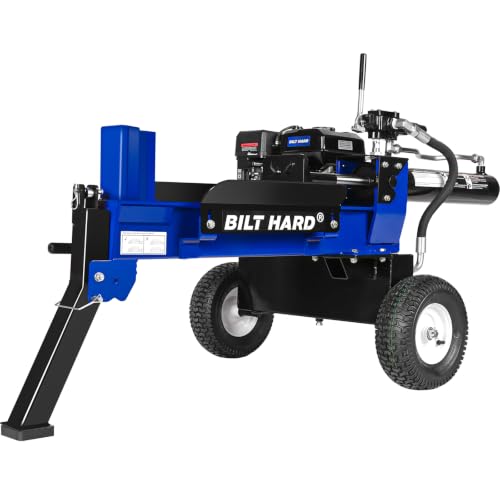

Product images: Amazon listings
Sources
- Champion Power Equipment — Operator's Manual, Model 201313 32-Ton Gas Powered Log Splitter (consulted Nov 2026)
- Champion Power Equipment — Operator's Manual, Model 100330-1 37 Ton Full Beam Log Splitter (consulted Nov 2026)
- WEN Products — Model 56207 Lumberjack 6.5-Ton Log Splitter manual (consulted Nov 2026)
- PowerSmart (manual hosted by Lowe’s) — Instruction Manual, 6 Ton Electric Log Splitter Model PS90 (consulted Nov 2026)
- Penn State Extension — Heating with Wood: An Introduction (consulted Nov 2026)